

Free shipping on all orders over $125*

Synbiotic Blend of 10 Beneficial Strains, Developed by Board-Certified Gastroenterologist

Children’s Health

Children’s Health Issues

woman working out on beach

How probiotics are helping babies born via C-Section

So, you’re a mom with a newborn baby and you are doing all you can to keep the little one healthy and happy.

You’re swamped with so many important things like sleep, feeding times and reading up on everything to avoid allergies, jaundice and infection. It can add up to information overload, so any new knowledge — like the way mothers pass beneficial bacteria to babies during birth — can be overwhelming.

This last of a two-part series will help moms get up to speed on the value of protecting their babies’ gut health by giving them probiotics every day, particularly if you have had a caesarean (C-section) or other health issues during your pregnancies.

Protecting your baby’s immune health after a C-section

For moms, making the decision to deliver your newborn baby via C-section is a tough one. Often, that choice is already made for you due to biological obstacles that make a vaginal birth dangerous.

How probiotics are helping babies born via C-SectionFor some women, however, it doesn’t lessen the stigma of a C-section birth, even when it’s necessary. There’s no need to feel any way but good when you make the best delivery choices for your health and your baby’s health.

Unfortunately, C-section babies face a very real problem right after they’re born, based on a recent Swedish study that compared the health of 24 babies delivered vaginally and by C-section.

Scientists analyzed fecal samples from all two dozen babies taken a week after birth then five additional times, and took blood samples at 6, 12 and 24 months to check levels of immune system chemicals (Th1 and Th2) that may play a role in future allergy problems.

C-section babies had less gut diversity — a lower range of good gut bacteria — during the first two years of their lives (specifically the Bacteroides phylum that allows the immune system to respond to the right triggers) compared to babies born vaginally. Also, C-section babies had unbalanced levels of Th1 in their blood, making them more vulnerable to developing allergies.

(A 2010 study published in the Proceedings of the National Academy of Sciences found infants who were born via C-section had a gut microbiome resembling the mother’s skin, less rich in bacteria.)

Swedish researchers discussed further investigations into treatments that would normalize the development of the microbiota of C-section babies, including fecal transplants and giving them a daily probiotic.

Preventing eczema with probiotics

The benefits of giving your babies probiotics don’t stop with providing them good gut health and naturally boosting their developing immune systems.

Atopic dermatitis, better known as eczema, is an uncomfortable skin rash many babies have that first appears on the cheeks and scalp, and may later spread to their chest, arms, legs and other parts of their little bodies.

Although science hasn’t found what triggers eczema, environmental irritants and allergens may initiate this scaly problem. Also, if you or your family members have suffered from allergies, asthma or eczema, your baby has a better chance of suffering from it, too.

A 2013 study published in Clinical & Experimental Allergy found giving moms probiotic supplements of a strain of Lactobacillus rhamnosus (one of the 10 strains contained in EndoMune Advanced Probiotic) during pregnancies, then afterward to the babies for two years reduced the incidence of eczema sharply.

New Zealand researchers compared the effects of different bacterial strains on Moms and their new babies until they reached age 6 to determine which one had the best probiotic punch.

Lactobacillus rhamnosus supplements given to moms then their babies up to age 2 reduced the incidence of eczema in children by an amazing 44 percent until age 6.

Conventional medicine remains skeptical

Researchers found that giving probiotic drops to infants produced worse results than giving them a placebo. However, those results fly in the face of others, including a March study in JAMA Pediatrics, that quantified the benefits of giving babies probiotics as a savings of $119.

The appeal for new moms giving their babies probiotics certainly outstrips any conflicting issues. The amount of pages found on Google with the search term probiotics for baby is far bigger (6.9 million) than probiotics by itself (4.6 million).

How probiotics are helping babies born via C-Section Read More »

Why more expecting mothers are taking probiotics

There are many things a woman can do to promote a healthy pregnancy including taking folic acid, limiting caffeine and maintaining healthy weight, according to the National Institute of Child Health and Human Development (NICHD).

These are great tips, but there’s one thing that’s conspicuously absent — caring for the gut health of mom and her baby.

This first of a two-part series discusses the growing number of studies that show how promoting good gut health benefits moms before their babies are born.

Once upon a time

To appreciate the importance of the microbiome to the health of newborns, it’s important to understand that scientists believed — not so long ago — that the mother’s womb was a sterile environment, and babies acquired the beneficial bacteria needed to survive after they were born.

More recent studies have found the exact opposite: Babies may be “seeded” with beneficial bacteria important to their long-term health.

Although science is still figuring out how those healthy bacteria get to the unborn fetus via mom’s microbiome, many experts agree that exposure to bacteria does the both a world of good, from teaching the growing immune system how to recognize and handle pathogens to fighting diseases.

In fact, Dr. Josef Neu, a University of Florida pediatrician, is one of a growing number of experts who believe premature births can be reduced, merely by fetuses having healthy amounts of beneficial bacteria.

Even more important, should harmful bacteria attack the fetus, Dr. Neu and others believe an immune reaction is triggered sending the mother into premature labor, not good for the health of mom and her infant.

Dr. Neu’s solution, as told to the New York Times, is giving moms a “microbial cocktail,” something that sounds a lot like taking a probiotic. In this scenario, doctors could prescribe specific species to protect the fetus from infections or premature delivery.

Probiotics and preeclampsia

A huge concern all new moms have is bringing their babies into the world on time and with as few problems as possible.

Preeclampsia, a serious complication affecting blood pressure with damage to kidneys or other organs, is one of those obstacles that prevent a full-term birth, according to the Mayo Clinic.

The treatment of preeclampsia can be problematic. If left untreated, mom and her baby can face serious or fatal health consequences. The only “cure,” the Mayo Clinic says, is delivering a baby. But, what if that preeclampsia diagnosis comes too early in the baby’s fetal development?

Taking a daily probiotic may not cure preeclampsia. However, according to a 2011 study published in the American Journal of Epidemiology that monitored the health of more than 33,000 Norwegian women, probiotics lessened the risks of preeclampsia by up to 39 percent in some cases.

Taking a lactobacilli-laced probiotic every day was linked to a 20 percent decrease in the risk of preeclampsia, and a steeper 39 percent drop in a more severe form of the disease.

Scientists hypothesize that probiotics may lessen inflammation levels (a possible trigger for the disease) or have an effect on human placental trophoblasts (cells that form the outside layer of the blastocyst that provides nutrients to the embryo and develop into a large part of the placenta).

Bacterial warning signs

There’s more good news related to mom’s microbiome that may provide early warning signs of premature birth, according to preliminary research conducted by scientists from the University of Pennsylvania and University of Maryland.

Investigators took vaginal swabs from pregnant women during two time periods — late second trimester (20-24 weeks) and early third trimester (24-28 weeks) — then compared the kinds of bacteria (called community state type or CST) taken from moms who gave birth at full term versus those who gave birth prematurely.

“The percent of non-CST III was significantly lower in samples from women delivering preterm than term. Notably, the differences in these microbial communities were evident in the late second trimester of pregnancy, weeks if not months prior to the preterm birth,” said Dr. Michael Elovitz, director of the Maternal and Child Health Research Program at the Perelman School of Medicine at the University of Pennsylvania.

“This study is the first to report such key differences in the CV (cervicovaginal) microbial communities weeks prior to preterm birth. If differences in the CV microbial communities are confirmed, then new and exciting therapeutic strategies will emerge to prevent preterm birth.”

Although they weren’t identified as a strategy in this recent study, taking a multi-strain probiotic like EndoMune Advanced Probiotic remains the safest and easiest way a mom can give her baby a healthy head start.

Why more expecting mothers are taking probiotics Read More »

Treat colic safely, inexpensively with probiotics

Watching your young infant struggle with colic after feeding is among the most upsetting experiences you’ll face during the early months of his or her life. Fortunately, the prolonged crying and discomfort your baby experiences due to colic or other digestive ailments will be brief, particularly if you follow our recent list of 10 ways to calm your baby naturally and safely.

One of the easiest and safest ways to treat colic, and help your baby develop good gut health that boosts immunity, is taking a multi-species probiotic containing 5 to 10 billion CFUs (colony-forming units) per day.

A recent Italian study, published in JAMA Pediatrics, concluded giving healthy babies a daily dose of probiotics shortly after they’re born may lessen episodes of prolonged crying as well as the development of common gastrointestinal problems, including acid reflux and constipation.

Italian researchers assigned some 550 infants born at full term to receive either daily drops of a probiotic mixed with oil or a placebo (an oil mixture) for three months. Parents of those infants also kept diaries detailing any problems (inconsolable crying, bowel movements and vomiting) along with the number of visits made to their pediatrician.

The babies who received probiotics were obvious to spot by the end of the 90-day study.

  • The time babies treated with probiotics experienced prolonged crying was 38 minutes, or almost half the time (71 minutes) of the placebo group.
  • The probiotic group had more bowel movements (4.2) compared to those receiving a placebo (3.6).
  • The placebo group experienced more daily problems with regurgitations (4.6) than the probiotic group (2.9).

Interestingly, Italian scientists were also able to quantify the monetary benefits of giving babies a probiotic. Families saved $119 for each child given a probiotic.

“Driving a change of colonization during the first weeks of life through giving lactobacilli may promote an improvement in intestinal permeability,” according to the Italian researchers. “Visceral sensitivity and mast cell density and probiotic administration may represent a new strategy for preventing these conditions, at least in predisposed children.”

These results mirror similar findings in a 2007 study that concluded babies treated with a multi-species probiotic like EndoMune Advanced Junior cried about two-thirds less than those given the gas-reducing drug simethicone.

Treat colic safely, inexpensively with probiotics Read More »

EndoMune Interview: Dr. Josephine Ruiz-Healy

This week we’re kicking off an ongoing series of interviews with noted health care experts who consider good gut health essential in treating a wide variety of health issues.

Our first interview with Dr. Josephine Ruiz-Healy discusses the various gut health benefits probiotics provide children. Dr. Ruiz-Healy is a Clinical Associate Professor of Pediatrics at the University of Texas Health Science Center (UTHSC) at San Antonio. In private practice for two decades in San Antonio, she is Board Certified in Pediatrics and Integrative Holistic Medicine.

A relatively recent trend in American medical circles, integrative medicine focuses on treating the mind, body and spirit – at the same time by using the best of conventional and alternative therapies to facilitate the body’s innate healing responses, naturally and effectively.

Dr. Ruiz-Healy discusses how probiotics, good gut health and other integrative health tips can help babies get started on the right foot, along with avoiding antibiotics as often as possible.

Recent studies have reported mixed results about probiotics being an effective treatment for colic. Have you found probiotics to be helpful?

There has been mixed results in limited studies. The studies themselves show wide variability in their designs and parameters to offer definite results. However, it is a fact that infants with colic have a different intestinal microbiota than their “non-colicky” counterparts. Colicky infants have mainly coliforms that are not well colonized with Lactobacillus.

A different pattern is also seen in babies not colonized at birth who are born via Caesarean section and infants who are not breast-fed. We find the use of probiotics to be beneficial in some of our colicky babies who have these commonalities. Choosing the right probiotic is important. Not all are created equal and they all have different functions.

Multivitamins can cause constipation for some kids. Can probiotics and a healthy diet help?

We try not to use multivitamins that have iron if we do not need to supplement for this deficiency. But, without a doubt, trying to eliminate processed foods and over-cooked foods that indeed change your microbiota and substituting them with foods that have their own healthy biofilm and increasing their water consumption certainly change the microflora.

How do children benefit most from taking a probiotic?

Children are living in a toxic “artificial” environment now. That toxicity is interpreted by many scared parents as “too many germs” and not realizing we are more bacteria than human cells.

We try to eliminate everything that seems “contaminated.” We sterilize our homes but our children attend day cares where they get sick. Also, that illness in many instances is treated with antibiotics regardless if it is warranted or not, and kills the good bacteria in our gut further compromising our immunity.

Probiotics help fill that void we have because of life in the 21st century. A good blend of live probiotics seems essential to protect our kids and help them develop and maintain a healthy immune system.

What does good gut health mean for young children?

Good gut health translates to a good immunity.

There is research ongoing that the microbiota in infants is different for infants who develop allergic diseases, at all system levels. This is influenced by many external factors. We can change some of these factors by keeping, via the adequate mix of probiotics, a healthy gut microbiota.

When do you prescribe a probiotic to a young patient?

We recommend probiotics to infants who are bottle-fed, breast-fed infants whose mothers are on antibiotics or do not plan to breastfeed long, infants entering day care and fussy colicky infants who have no other underlying problems. It is essential children have a healthy gut microbiota before age 2!

Physicians are finally realizing the overprescribing of antibiotics is a serious health problem, although certain conditions require them. How do you advise parents?

Whenever we have children on antibiotics, we recommend probiotics rich in S. boulardi and we recommend they stay on them for at least a month before they change to a different mix of probiotics.

What other integrative health tips can you suggest to parents wanting to bolster their child’s gut health in addition to probiotics?

  • Avoid toxins!
  • Having parents understand that some fever is good for you and it is not a disease, and physicians taking the time to explain why not every time a child gets sick he/she needs antibiotics.
  • Give them vitamins every day.
  • Serve kids at least 6 servings per day of veggies and fruit, because it is the junk and processed foods that hurt them.
  • Decrease milk products.
  • Make kids get outside and play everyday.
  • Do not apply sunblock every time a kid goes outside. Let them get sunblock-free sun for at least 10 minutes.
  • Limit the time playing video games and watching TV.

EndoMune Interview: Dr. Josephine Ruiz-Healy Read More »

9 back-to-school health tips for parents

You can look at back to school time one of two ways. On one hand, this is a great time of the year. Your kids are moving upward on the educational ladder and heading off to new experiences, filling you with pride and joy.

With all the changes you and your kids are experiencing, unfortunately, stressors are sure to follow. Adjusting to new schedules and new schools are the most common stressors, followed close behind by exposure to viruses and assorted cold and flu bugs from classmates.

That’s why these back to school health tips for kids are so essential to protect your kids.

Taking a multi-species probiotic once a day can treat many of these emotional and bug-related problems very simply and safely, without the need for a drug, especially an antibiotic that can seemingly worsen health problems as often as they treat them successfully.

In fact, studies have shown as many of 50 percent of the kids treated with antibiotics for something as simple as an ear infection will develop antibiotic-associated diarrhea (AAD).

However, a recent assessment of 16 studies by the Cochrane Database System Review  (including kids as young as two weeks old and as old as 17 years) found those who had been given a probiotic along with antibiotics lessened incidents of AAD by 50 percent.

Even better, kids who were given probiotics with higher colony counts of beneficial bacteria lowered their odds of suffering from antibiotic-related diarrhea by an amazing 63 percent.

Other tips parents can take to ensure the health of their children—no matter how old they are—is protected in addition to taking a probiotic:

  • Train them to wash their hands as often as possible.
  • Help kids better handle the events that boost their stress levels to harmful levels by setting good examples for them.
  • Get your kids off to a good start by ensuring they eat nutritious meals, starting with a good breakfast.
  • Make sure your kids are getting the exercise their bodies need every day.
  • Pack those backpacks children use to carry lunches and books lightly, while ensuring they’re equipped with wide, padded straps.
  • Keep your kids, no matter how old they are, on a consistent sleep schedule of at least 9 hours every day if not longer.
  • Are your kids up-to-date with all their immunizations before heading back to school? Protect them and their classmates by keeping your kids current on all their shots.
  • When was the last time your child had an eye exam? Protect their vision and improve their grades by making an appointment.

EndoMune hopes your back-to-school week goes well!

9 back-to-school health tips for parents Read More »

EndoMune Jr. now Parent Tested Parent Approved

ptpa-RGB-300dpi-larg1EndoMune Advanced Jr., the only children’s probiotic developed by a board-certified gastroenterologist, has won the much-coveted Parent Tested Parent Approved (PTPA) Winner’s Seal of Approval.
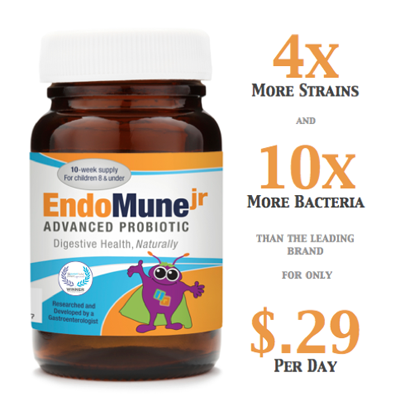
EndoMune Jr. is the first and only probiotic to be recognized by PTPA, the largest volunteer parent-testing organization in North America with more than 60,000 members.

To celebrate their new website (http://ptpa.com), PTPA, will host a Twitter party Oct. 25 from noon to 2 p.m. EDT, which will feature EndoMune Advanced Jr. The fun and informative online gathering also will include prizes of EndoMune Jr. and other PTPA-approved products. Three lucky winners will leave the party with a free jar of EndoMune Jr.

Look for the PTPA Twitter party by checking out @PTPA and looking for the hashtag #ptpaparty.

Endomune Jr.“At PTPA Media, we are proud to play a role in certifying innovative products that families can trust,” says Sharon Vinderine, CEO and founder of PTPA Media Inc. “When consumers search for our Seal of Approval on product packaging and web sites, they are essentially searching for validation from their peers.  Their peers will have objectively tested and approved these products based on their performance in a real life environment. That type of resource for families is priceless.”

Among the glowing compliments EndoMune Jr. received from PTPA reviewers:

  • This product was very easy to use. I really like the scoop that came with the product. It gave my oldest a chance to scoop it out herself and know she got it right. I also like how you just put it directly into the kid’s drink instead of having them take a pill every day.
  • We had been using probiotics for a while, as my kids were preemies and have had a lot of GI issues. I like that this probiotic doesn’t have the extra ingredients that gummies have. The kids drank it fine when put in juice and they had no digestive issues or sicknesses while they were on it. We will continue on this product. Thank you for making a good, safe probiotic for ALL ages.
  • The EndoMune Advanced Junior was easy to take and offered more than the typical probiotic.

Read more of the comments from parents who tested EndoMune Kids.

EndoMune Kids and its adult counterpart, EndoMune Advanced Adult Probiotic, are completely GMO-free and contain no dairy products, preservatives, artificial coloring or gluten.

EndoMune Jr. now Parent Tested Parent Approved Read More »

How to treat colic: 10 ways to calm your baby naturally and safely

endomune-baby colic copyOne of the most helpless feelings a new mom experiences is watching her newborn baby screaming at the top of his or her lungs inconsolably for hours that feel like an eternity, usually after feeding.

You read all the books and watched all the videos you could…but nothing really prepared you for how to treat colic in your otherwise healthy and happy baby.

All babies cry a great deal during the first few months, but how do you know when it’s time to worry? A rule of thumb for determining the difference between emotional crying and unexplainable outbursts of crying connected to colic, health experts say, is all about the “rule of threes.” For a baby to be diagnosed as colicky, he or she must cry for a minimum of three hours, at least three days a week, starting in the first three weeks of life.

Unfortunately, that’s not all. Some pediatric experts are concerned prolonged bouts of crying may affect a baby’s development, too.

Other concerns: Moms may be worsening the problem by overfeeding their babies or exposing them to the flood of emotions they’re feeling, but not doing a good job of shielding, from their newborn.

The good news for moms is that most babies grow out of their colicky ways by the time they’re 6 months old. But, how to treat colic shouldn’t be a waiting game, as there are plenty of ways to end it, safely and effectively.

Here are 10 ways to treat colic and help you and your baby get the rest and relaxation both of you need.

1. Modify your baby’s diet by eliminating irritating foods from your own diet — caffeine, dairy products and spicy cuisine — if you’re breastfeeding.

2. When you feed your colicky baby, make sure to hold that noisy bundle of joy as upright as possible. (This tip can reduce your baby’s risks of heartburn, too.)

3. Introduce soothing sounds like a fan, white-noise machine or a dryer to your baby’s environment.

4. Singing quietly to your baby not only soothes your baby but also lightens your mood.

5. Has your baby used a pacifier? Even breastfed babies can benefit from sucking on a pacifier to calm down.

6. The gentle motion your crying baby feels when taking a drive in a moving car can soothe his or her bad mood.

7. Walk away from your crying, colicky baby for a few minutes. You’ll be a better parent and able to handle those loud emotional cries from your stressed baby if you can take a short break.

8. Schedule break time from a trusted friend or family to give you a brief, calming respite.

9. Swaddling your baby (wrapping your infant snugly in a blanket to mimic the warmth of the womb) before putting him or her to bed may help them stay asleep.

10. Studies have shown treating your colicky baby with a multi-species probiotic containing 5-10 billion CFUs (colony-forming units) per day may be beneficial. A 2007 study concluded babies treated with a probiotic like EndoMune Advanced Junior cried about 66 percent less than those given simethicone, a drug that reduces gas.

How to treat colic isn’t a mystery, and these 10 tips should help provide you and your baby some much-needed relief.

How to treat colic: 10 ways to calm your baby naturally and safely Read More »

Timing is Everything clock graphic

How and when to take a probiotic

When Should You Take a Probiotic?

Probiotics are one of the few health supplements that actually work, and they provide many benefits for your overall health. Probiotics help maintain a strong immune system by increasing the number of good bacteria in your gut. In turn, a healthy immune system helps your body ward off disease, making probiotics beneficial for both your digestive system and overall health. That’s why doctors like myself recommend them worldwide.

While there are numerous benefits of probiotics, we first need to understand what they are and how they establish themselves into our gut.

To begin, note an important fact: many people don’t realize that probiotics are not man-made, although there are man-made probiotics which are used in probiotic supplements. In fact, we, as humans, have been taking probiotics for thousands of years!

Every civilization around the world struggled to preserve food before we created refrigeration and other modern methods of food preservation. Each of those civilizations discovered that fermenting food could make it last longer. For example, foods like yogurt, sauerkraut, and even fermented pickled vegetables contain probiotics. Simply put, if you alter your diet to consume large quantities of fermented foods – you probably wouldn’t need to take probiotic supplements at all.

Your Stomach is a Problem

Both natural probiotics and probiotic supplements contain live beneficial bacteria. However, before probiotics from either food or supplements can help you, the beneficial bacteria must live and thrive in your gut.

A certain number of bacteria live in your stomach, but the vast majority of probiotic bacteria live in the lower portions of our Gastrointestinal (GI) Tract; specifically, your large and small intestines. To reach their ideal final destinations, the probiotic bacteria have to pass through your stomach and survive the acids it creates to break down food.

Our stomachs produce acid to “digest” the food we eat so the nutrients contained in food can be absorbed by your intestines. Unfortunately, your stomach acid will kill most bacteria, both good and bad, so it’s critical that beneficial probiotic bacteria are protected as they pass through the stomach.

EndoMune Advanced Probiotics have a special capsule designed to resist stomach acid and deliver as much probiotic as possible to your lower GI tract.

Some people try to thwart the stomach acid problem by taking probiotics with a meal, and we do lean towards that idea, but only if it’s a light meal. We don’t suggest taking probiotics with heavy meals because heavy meals take longer to digest, and actually might subject any beneficial probiotic bacteria to stomach acid for a longer period of time. In other words, heavier meals take longer to digest, trapping any probiotic bacteria in an acid bath for a longer period, making them more vulnerable.

The answer to the question of how to take a probiotic is actually another question – when is the best TIME to take a probiotic?

The Best Time to Take a Probiotic

When you take a probiotic will vary depending on your age and health. Another important factor to consider is why you originally began taking probiotics. For example, if you suffer from diarrhea or bloating, you gain the most benefit from probiotics by taking supplements at every meal.

If you have trouble staying asleep, the best time to take beneficial bacteria is right before bed. Did you know there is a proven connection between your gut and your liver? That means people with liver issues tend to have more insomnia than those with healthy livers.

Nevertheless, for most of us, the ideal time to take probiotics is 30 minutes before breakfast. Arguably, breakfast is the one meal we eat every day, at the same time, which makes it an ideal time to take your probiotic since you can easily fit it into your routine. Since breakfast often includes a fatty food like milk, muffins, or eggs and bacon, the probiotics better survive your stomach acid and find the lower portions of your gastrointestinal tract, where they do their best work. That’s why breakfast is an excellent choice.

If you’re not a fan of breakfast, you should consider your personal circadian rhythm to help determine what is the best time for you to take probiotics. We discussed previously why breakfast-eaters may benefit more by taking probiotics in the morning, but taking probiotics at night may be just as effective for night owls. In fact, research suggests that the bacteria in our gut directly affects our circadian rhythm. You can read more about probiotics and your circadian clock in a previous blog here: https://endomune.com/your-circadian-clock-and-gut-health-are-linked

Despite any personal nuance to when your absolute best time to take a probiotic, there are some general guidelines below you can use as a starting point to gain the most benefits from your probiotics.

For Healthy Adults

Take a multi-strain probiotic like EndoMune Advanced Probiotic consistently on an empty stomach at least a half-hour before eating your first meal of the day. This allows most of the beneficial bacteria to survive when stomach acid levels are lower as they travel to your gut.

For Healthy Kids

From infants to toddlers up to age 3, I recommend giving these small children a probiotic in a powdered form like EndoMune Jr. Advanced Probiotic Powder. Sprinkle one half-teaspoon of this powder on soft foods, in a formula, or in a non-carbonated liquid.

For children from ages 3-8, taking a probiotic in a tablet form designed specifically for this age group should be an easy way to ensure they have happy, healthy guts too. EndoMune Jr. Advanced Chewable Probiotic is a perfect way to deliver beneficial probiotics to your children in this age group.

Taking a Probiotic When You’re Sick

Taking a probiotic when you are sick is one of the best things you can do to give your immune system a boost, especially when your doctor prescribes an antibiotic. If you’re taking an antibiotic you’ve taken repeatedly in the past, you’ll gain even more benefits from probiotics.

Antibiotics can wipe out the good bacteria in your gut, allowing the less desired bacteria to hang around. In worst case examples, bad bacteria can proliferate, and perhaps even thrive resulting in serious health problems like grave Clostridium difficule (C. diff) superbug infections that can be deadly.

When you’re taking an antibiotic, it’s important to give your probiotic at least a two-hour head start to give those beneficial bacteria the best chance to reach and protect your gut.

Talk to your doctor first!

Before you begin taking a probiotic, be sure to talk to your doctor about any health concerns you may have. Consulting your physician is critical if you are taking certain drugs, like an immunosuppressants or antifungals. Knowing how and when to take a probiotic can dramatically affect how well they work.

If you’ve tried probiotics before and were less than impressed with your results, try taking them again and stay consistent with some of the tips mentioned above. You want to ensure you are not losing some or most of the probiotic and prebiotics benefits before they had a chance to reach your GI tract. That’s essentially the only way to really see if they will improve both your gut and overall health.

Frontiers in Pharmacology

Beneficial Microbes

Nature Reviews

American Journal of Health-System Pharmacy

How and when to take a probiotic Read More »

Soothe Your Baby’s Colic with Probiotics

Babies cry for a variety of reasons: they’re hungry, they’re thirsty, they need changing or they’re sick.  Sometimes they cry for no apparent reason at all.  This is called infantile colic.  A colicky baby cries or shows symptoms of discomfort, such as moaning or fussing, for up to several hours.

Three recent studies published by the National Center for Biotechnology Information found that many babies with infantile colic had an inflamed intestine caused by certain bacteria.  Based on the results, scientists concluded that higher levels of beneficial bacteria, like those found in probiotics, lessened intestinal inflammation in babies.

Like adults, babies benefit from a healthy balance of intestinal bacteria that are found in probiotics.  EndoMune Kids contains billions of bacteria that improves intestinal digestion, helping relieve colic and ease babies’ distress.

Soothe Your Baby’s Colic with Probiotics Read More »

Keep Your Child Cold and Flu Free

Recently, the flu and cold have been spreading around. All it takes is a cough or sneeze from someone who is already sick for you or your child to get sick. During this time of year, it is important to keep your child healthy and probiotics may help.

In a recent study published in the Journal of the American Academy of Pediatrics, more than 300 children were divided into three groups to study the effect of probiotics on cold and flu-like symptoms. The children, who ranged in age from three years old to five years old, were either given a placebo, a Lactobacillus acidophilus probiotic or a combination of Lactobacillus acidophilus and Bifidobacterium animalis

The results from the study concluded that those who consumed the probiotic supplement daily for six months suffered significantly less cold and flu-like symptoms. These participants showed between 50 and 72 percent less fevers, 41 to 62 percent less coughing and 28 to 59 percent less runny noses, overall.

With the colder weather and children back in schools, taking a daily probiotic supplement, like EndoMune Jr., may help not only treat, but prevent your child from becoming ill.

Before starting your child on a probiotic regimen, it is always best to consult with your child’s physician.

Keep Your Child Cold and Flu Free Read More »

Scroll to Top