Probiotic supplements are emerging as a simple daily habit that may help protect the aging brain, especially for middle‑aged and older adults, and multi‑strain, higher‑CFU products like EndoMune Advanced Probiotic fit closely with what recent studies suggest is effective. While probiotics are not a cure for dementia, growing evidence shows they can support memory, processing speed, and overall cognitive function as part of a broader brain‑healthy lifestyle.
Key Takeaways on How Probiotics Affect Cognition
- Probiotics can modestly improve memory, processing speed, and spatial skills in middle‑aged and older adults, especially after about 12 weeks of daily use at around 20 billion CFU or more.
- Benefits for younger people are more targeted – for example, executive function in children and verbal skills in young adults – rather than broad cognitive boosts.
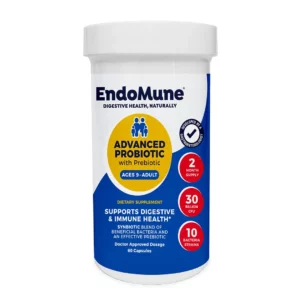
- EndoMune Advanced Probiotic provides 30 billion CFU and 10 different strains plus a prebiotic, aligning well with research that favors multi‑strain, adequately dosed probiotic formulas for brain and gut support.
What The New Study Found
A 2025 meta‑analysis in the European Journal of Clinical Nutrition combined 21 randomized controlled trials, including people from infancy to over 90 years old, to ask a simple question: do probiotics help the brain, and at what ages?
The researchers found that the clearest and broadest benefits appeared in middle‑aged and older adults, where probiotics significantly improved overall cognitive performance, memory, processing speed, and spatial ability.
In this older group, the best results appeared after 12 weeks of daily probiotic use, with doses around 20 billion CFU. The improvements were modest but meaningful, suggesting probiotics can help aging brains stay sharper for longer.
How Age Changes the Brain Benefits
The same meta‑analysis and related reviews show that age matters for how probiotics affect cognition.
- In infants and children, probiotics did not dramatically change overall cognitive development scores, but they did improve executive functions such as planning, mental flexibility, and handling multiple tasks—especially when taken for six months or longer.
- In healthy young adults, probiotics did not significantly boost global cognition or memory, but they were linked to better verbal ability, which may reflect a “smaller room for improvement” in already high‑functioning brains.
Across all age groups, one consistent finding stands out: probiotics did not reliably change attention span, suggesting their primary effects lie in memory and information processing rather than simple focus.
Supporting Science Beyond One Paper
The new lifespan meta‑analysis is part of a much broader body of research connecting the gut and brain. A 2025 systematic review of probiotic supplements in adults over 18 found significant improvements in global cognition after at least 12 weeks of use, using standard tests like the MMSE and MoCA. Another 2025 meta‑analysis focused on patients with cognitive impairment (such as mild cognitive impairment or early dementia) reported that probiotics produced a moderate improvement in cognitive scores, with particularly strong effects in studies around 12 weeks long.
Earlier work showed similar patterns: probiotic supplementation in older adults with mild cognitive problems suggests better memory performance and lower inflammation markers, supporting the idea that gut bacteria can influence brain health through both immune and metabolic pathways.
Why Probiotics Might Help Your Brain
Scientists point to the “gut–brain axis” – the constant two‑way communication between intestinal microbes and the central nervous system – to explain these effects on the brain. Probiotic bacteria can:
- Reduce chronic inflammation and oxidative stress, both of which are strongly linked to faster brain aging and higher dementia risk.
- Produce or modulate key brain chemicals like gamma‑aminobutyric acid (GABA), serotonin, and dopamine, which influence mood, motivation, and cognition.
- Increase levels of brain‑derived neurotrophic factor (BDNF), a protein that supports neuron survival and new connections, which is crucial for learning and memory.
Together, these actions create a friendlier environment for brain cells, helping preserve cognitive function as people age.
Where EndoMune Advanced Probiotic Fits In
Although research does not endorse a single “magic” brand, it does highlight some formula features that matter: an adequate dose of probiotics, multiple strains, and, ideally, prebiotic support. EndoMune Advanced Probiotic meets all these requirements by providing:
- 30 billion CFU per capsule—above the 10–20 billion CFU per day range many studies call effective for humans, and higher than the ~20 billion CFU used in several cognitive trials.
- 10 beneficial strains from Lactobacillus, Bifidobacterium, and related species, which reflects evidence that diverse multi‑strain formulas supports different gut and immune functions at the same time.
- Added prebiotic fiber (FOS), which feeds the beneficial bacteria and helps them thrive in the intestine, an approach often called “synbiotic” when probiotics and prebiotics are combined.
EndoMune is also formulated for daily use and shelf‑stable potency, making it practical to maintain the kind of consistent, multi‑month intake that brain studies suggest is important.
How To Use These Studies In Daily Life
For someone in mid-life or older who wants to support long‑term brain health, the evidence points to a few practical steps.
- Consider a daily multi‑strain probiotic at 20–30+ billion CFU, such as one capsule per day of EndoMune Advanced Probiotic, and plan to stay consistent for at least 12 weeks before judging the effect.
- Pair probiotics with a brain‑healthy lifestyle: a fiber‑rich, plant‑forward diet, regular physical activity, good sleep, and avoiding highly processed, pro‑inflammatory foods, which are linked to faster brain aging.
- Talk with a healthcare professional, especially if you have serious medical conditions or take immune‑suppressing medications, since most studies involve generally healthy or mildly impaired adults.
The bottom line: probiotics are not a stand‑alone treatment for cognitive diseases, but they are a scientifically supported, easy way to give both your gut and your brain an extra layer of protection – particularly when you choose a well‑designed, multi‑strain probiotic like EndoMune Advanced Probiotic and use it consistently over time.
Sources:
- https://pubmed.ncbi.nlm.nih.gov/40983638/
- https://pmc.ncbi.nlm.nih.gov/articles/PMC12645680/
- https://academic.oup.com/nutritionreviews/article/83/11/2144/8251945
- https://www.psypost.org/study-finds-age-dependent-cognitive-benefits-from-probiotic-consumption/
- https://www.frontiersin.org/journals/pharmacology/articles/10.3389/fphar.2024.1348297/full
- https://journals.plos.org/plosone/article?id=10.1371%2Fjournal.pone.0321567
- https://www.aging-us.com/article/102810/text
- https://pmc.ncbi.nlm.nih.gov/articles/PMC7861012/
- https://pubmed.ncbi.nlm.nih.gov/36629438/
- https://www.psypost.org/pro-inflammatory-diets-linked-to-accelerated-brain-aging-in-older-adults/
- https://pmc.ncbi.nlm.nih.gov/articles/PMC11980270/
- https://www.linkedin.com/posts/erwinloh_study-finds-age-dependent-cognitive-benefits-activity-7403025274164195328-v_0X